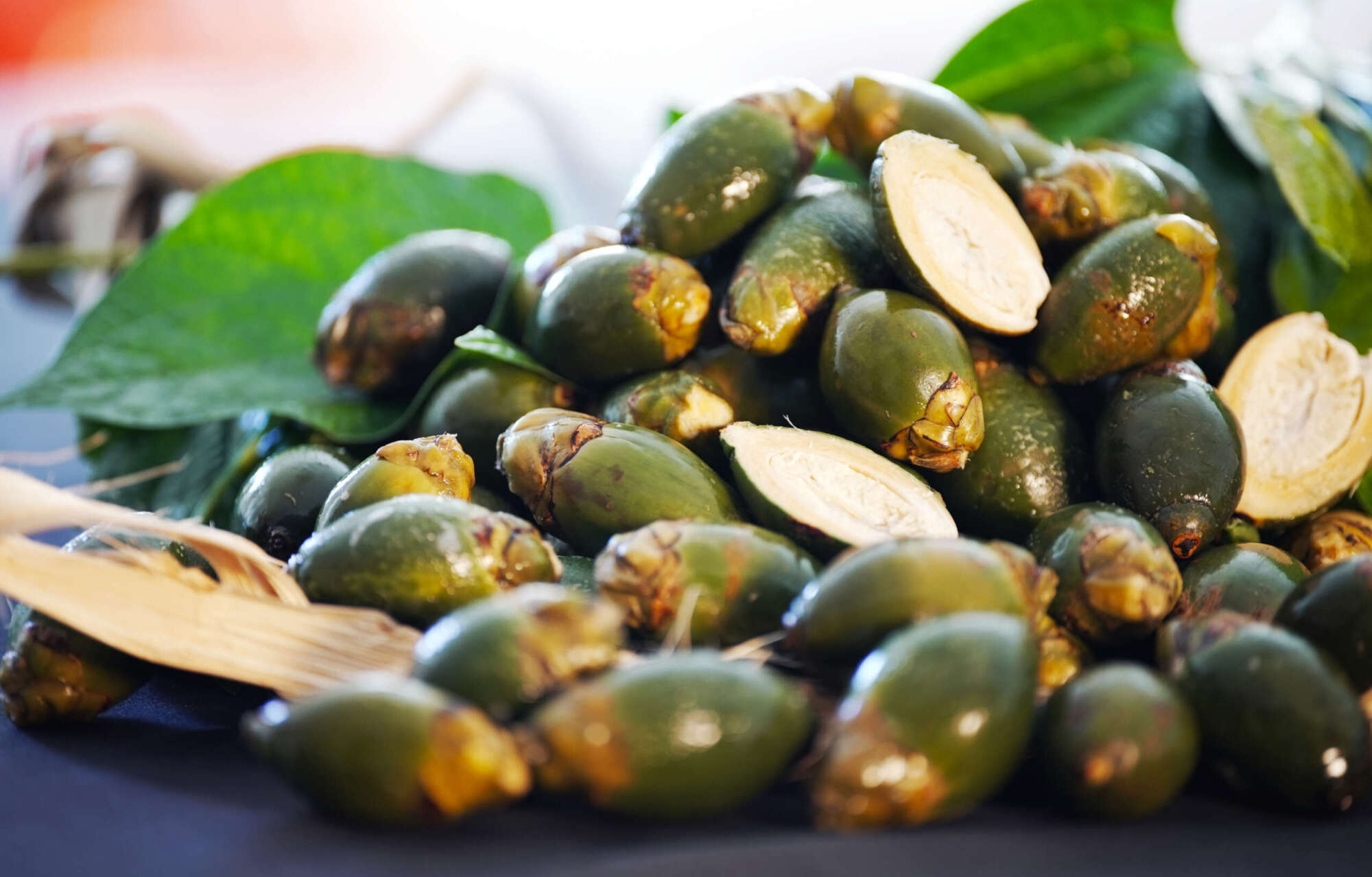
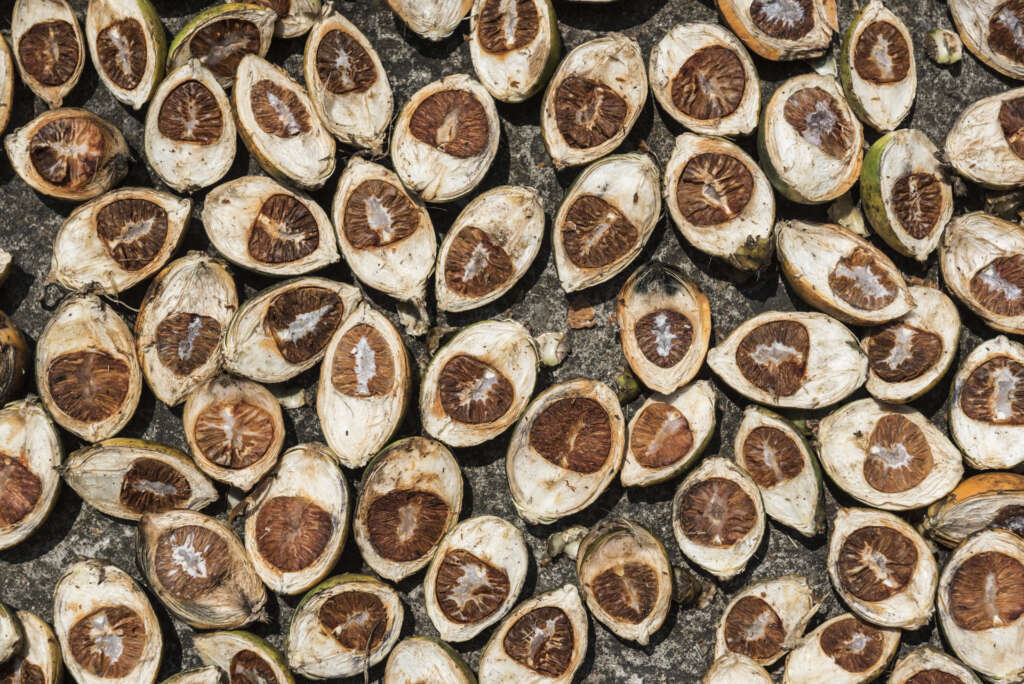
Betel nut, also known as areca nut, is the seed of the fruit of the areca palm. It is grown and cultivated throughout India, Southeast Asia and the Pacific, and it is widely sold in the United States. The term betel nut actually derives from the betel tree leaves that are often rolled with the areca nuts when chewed.
The main psychoactive ingredient in Betel Nut is called arecoline. Arecoline is a highly addictive stimulant that greatly enhances energy and mood, similar to caffeine or nicotine. It is most often chewed, either alone or cut with tobacco and slaked lime powder, in what is called a betel “quid.” Betel nut chewing causes overproduction of blood-red saliva, and prolonged use causes teeth and gums to turn red and eventually black. The presence of arecoline within betel nut makes chewing highly addictive, and combining the nut with slaked lime powder creates microscopic cuts in the gums to accelerate its stimulating effects.
CULTURAL SIGNIFICANCE
In some places, particularly in Southeast Asia and Melanesia, betel nut chewing has deep cultural and socioeconomic roots. It is a practice that dates back thousands of years. Discoveries made in the Philippines suggest that betel nut was chewed there as far back as 3,000 B.C.E. And a more recent discovery in Thailand found betel nut may have been chewed even earlier, approximately 6,000 years ago.
Betel nut cultivation and use has since spread significantly throughout South and Southeast Asia, Melanesia and western Micronesia. Throughout these regions, betel nut chewing is a popular social recreation similar to smoking tobacco or consuming coffee and alcoholic drinks. It also holds some religious significance. Under Hinduism, betel nut is sometimes consumed ceremonially and is presented as a sacred offering during worship.
HEALTH IMPACTS
Betel nut chewing, especially as a quid, is known to cause several negative health effects over long periods of use. These include oral lesions, oral cancers and cardiovascular diseases.
The health impacts of betel nut chewing have been studied since the early 1900s. One of the first peer-reviewed studies that noted betel nut’s health impacts was published by British Medical Journal in 1924. Subsequent studies over the last century continue to document betel nut’s global health impact, particularly its cancer-causing effects. For example, The New England Journal of Medicine reported that nearly half of Papua New Guinea’s population – approximately 4.5 million – chews betel nut. Concurrently, Papua New Guinea has some of the highest incidences of oral cancer in the world. It is the most prevalent cancer amongst men and third most prevalent amongst women.
In 2012, the World Health Organization classified betel nut as a group 1 carcinogen due to its long-documented health effects. The International Agency for Research on Cancer has also classified betel nut as a group 1 carcinogen.
CONSUMPTION AND REGULATION
Papua New Guinea is the largest per capita consumer of betel nut in the world, with more than half of its population of 9 million chewing betel nut. India, China, Taiwan and Myanmar are also among the world’s largest betel nut consumers.
India is also the world’s largest producer and exporter of betel nut. According to data collected by the Food and Agriculture Organization of the United Nations, India harvested nearly 1.4 million tons of areca nuts in 2023, which accounted for more than half of global areca nut production.
In Taiwan, a significant importer of betel nuts, chewing betel nut is considered endemic. The Taiwanese government has supported legislation and education efforts to reduce betel nut consumption over the last few decades. But consumption amongst the Taiwanese working class remains prevalent. Health studies conducted in Taiwan have also shown that betel nut consumption is independently associated with higher risks of cardiovascular disease.
In the Pacific, the nations of Guam, Palau and the Solomon Islands are significant consumers of betel nut. Some Pacific Island nations have begun implementing laws to limit betel nut consumption to protect communities from its negative health effects, especially youth. In countries such as Guam and the Commonwealth of the Northern Mariana Islands (CNMI), it is illegal to sell betel nut to youth under 18. And in the Republic of the Marshall Islands, there is a total ban on the import of betel nut.
In the United States, betel nut availability and consumption is more prevalent in areas of the country where Asian and Pacific Islander communities are concentrated, such as Hawai’i and the Pacific Northwest. Betel nuts can be purchased from most Asian grocery stores and Pacific Islander corner markets. It is not required that betel nuts sold in the United States carry warning labels highlighting its long-term health impacts. Additionally, there are no federal or state-level age limits to purchase betel nut.
REFERENCES
Kozlakidis Z, Cheong HI, Wang H. Betel Nut and Arecoline: Past, Present, and Future Trends. Innovations in Digital Health, Diagnostics, and Biomarkers 1 January 2022; 64–72. DOI: https://doi.org/10.36401/IDDB-22-05

Lin WY, Chiu TY, Lee LT, Lin CC, Huang CY, Huang KC. Betel nut chewing is associated with increased risk of cardiovascular disease and all-cause mortality in Taiwanese men. Am J Clin Nutr. May 2008 ;87(5):1204-11. DOI: 10.1093/ajcn/87.5.1204. PMID: 18469240.

Moss WJ, M.D. The Seeds of Ignorance — Consequences of a Booming Betel-Nut Economy. New England Journal of Medicine. September 2022. 1059-1061 VOL. 387 NO. 12. DOI:10.1056/NEJMp2203571

Papke RL, Horenstein NA, Stokes C. Nicotinic Activity of Arecoline, the Psychoactive Element of "Betel Nuts", Suggests a Basis for Habitual Use and Anti-Inflammatory Activity. PLoS ONE. October 2015. 10(10): e0140907. DOI: https://doi.org/10.1371/journal.pone.0140907

Pobutsky AM, Neri EI. Betel nut chewing in Hawai'i: is it becoming a public health problem? Historical and socio-cultural considerations. Hawai’i Journal of Medicine and Public Health. January 2012 71(1):23-6. PMID: 22413101; PMCID: PMC3298432.

Shah NC. Betel Industry in India & South and South East Asia:
The History of Areca catechu(Betel-nut, supari) &
Piper betel (Betel-leaf, Pan) in India (Part I-V). The Scitech Journal. January 2015.

Zumbroich TJ. The Origin and Diffusion of Betel Nut Chewing: A Synthesis of Evidence from South Asia, Southeast Asia and Beyond. eJournal of Indian Medicine. May 2009. Vol. 1 87-140.